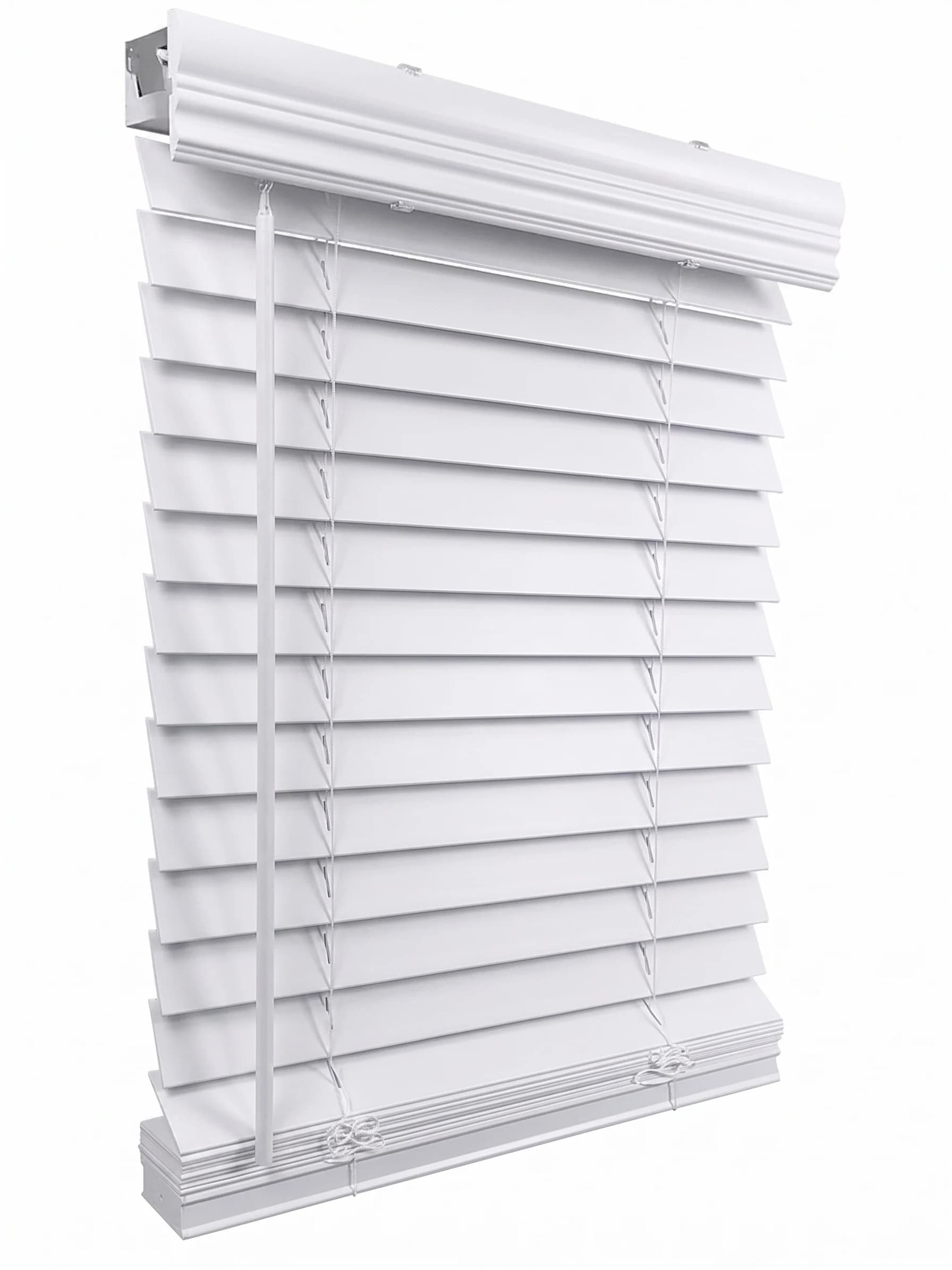

Window opening to blind width (inside mount)
Inside-mount blinds are ½" narrower than the opening, so stock widths end in “.5”: a 35" opening takes a 34.5" blind, a 58" opening a 57.5" blind. Measure the opening at the top, middle, and bottom and use the narrowest number. Prices are live for the 72" drop in 2" faux wood.
| Window opening | Blind width | Shop (72" drop) | Commonly used for |
|---|---|---|---|
| 24" | 23.5" | 23.5 × 72$64.10 | Door glass and narrow utility windows (see door blinds below) |
| 32" | 31.5" | 31.5 × 72$76.24 | Standard bedroom and living-room windows |
| 34" | 33.5" | 33.5 × 72$81.08 | Common single-hung |
| 34.5" | 34" | 34 × 72$87.58 | Between standard 34" and 35" openings |
| 35" | 34.5" | 34.5 × 72$88.80 | Most common single-hung width in new construction |
| 39" | 38.5" | 38.5 × 72$93.18 | Larger bedroom and living-room windows |
| 43" | 42.5" | 42.5 × 72$102.86 | Wide bedroom and great-room windows |
| 47" | 46.5" | 46.5 × 72$117.84 | Double-hung and small picture windows |
| 58" | 57.5" | 57.5 × 72$144.76 | Wide casement and picture windows |
| 59" | 58.5" | 58.5 × 72$146.88 | Wide-format picture windows |
| 71" | 70.5" | 70.5 × 72$170.62 | Large picture and sliding windows |
| 72" | 71.5" | 71.5 × 72$173.04 | Wide picture windows and patio coverage |
Typical inside-mount pairings. Always confirm your exact opening and mount type before ordering.
Window height to blind length
Pick the stock length at or just above your window height. Measure the inside height at the left, center, and right and use the longest. Stock 2" faux wood lengths are not cut down — the extra slats rest on the sill — so a 58" window takes a 60" blind and a 70" window a 72" blind.
| Window height | Stock blind length | Typical window |
|---|---|---|
| Up to 36" | 36" | Bathroom, over-tub, and kitchen-sink windows |
| 36⅛"–48" | 48" | Small bedroom and half-height windows |
| 48⅛"–60" | 60" | Standard single-hung in most bedrooms |
| 60⅛"–64" | 64" | Door glass and taller single-hung |
| 64⅛"–72" | 72" | Tall living-room windows and full-lite doors |
| 72⅛"–84" | 84" | Tall picture windows and French doors |
| 84⅛"–96" | 96" | Two-story and transom-height openings |
Blind sizes for common window sizes
Width and length together for the window sizes we see most. Inside mount subtracts ½" from the width and uses the next stock length; outside mount adds 3" to both.
| Window (W × H) | Inside-mount blind | Outside-mount blind | Typical window |
|---|---|---|---|
| 24" × 36" | 23.5 × 36$45.96 | about 27 × 39 | Bathroom or utility window |
| 36" × 48" | 35.5 × 48$69.80 | about 39 × 51 | Small bedroom window |
| 36" × 60" | 35.5 × 60$76.84 | about 39 × 63 | Standard single-hung |
| 36" × 72" | 35.5 × 72$91.22 | about 39 × 75 | Tall single-hung |
| 48" × 48" | 47.5 × 48$76.64 | about 51 × 51 | Kitchen or slider window |
| 48" × 60" | 47.5 × 60$95.80 | about 51 × 63 | Double-hung or bedroom slider |
| 60" × 60" | 59.5 × 60$120.00 | about 63 × 63 | Living-room picture window |
| 72" × 72" | 71.5 × 72$173.04 | about 75 × 75 | Large picture window |
Inside Mount vs. Outside Mount
Inside mount
The blind sits inside the window frame for a clean, built-in look. Report the exact opening width and the factory deducts ½" for clearance. Needs enough frame depth for the headrail.
Outside mount
The blind mounts on the wall or trim and overlaps the opening by about 1.5" per side. Order it wider and taller than the opening. Best for shallow frames, out-of-square openings, or maximum light blocking.
Outside-mount sizes by opening width
| Opening width | Outside-mount blind (1.5" per side) | Maximum privacy (2" per side) |
|---|---|---|
| 24" | 27" | 28" |
| 35" | 38" | 39" |
| 47" | 50" | 51" |
| 71" | 74" | 75" |
Jamb depth: will a 2" faux wood fit?
New-build windows usually have enough depth for 2" faux wood inside mount (roughly 1½"–2½" clear in the frame). Shallow trim, storm windows, or decorative casings may need outside mount or a slimmer 1" vinyl mini.
Inside-mount deduction by product
Blinds take a ½" width deduction; roller shades do not. In our configurators, choose Window Measurement and enter the opening — we apply the right deduction for the product.
| Product | Inside-mount width | Length |
|---|---|---|
| 2" faux wood blinds | Blind is ½" narrower than the opening | Stock lengths are not cut — choose the drop at or above the window height |
| 2" real wood blinds | Blind is ½" narrower than the opening | Height as measured |
| 1" vinyl mini blinds | Blind is ½" narrower than the opening | Height as measured |
| Roller shades | Enter the exact opening — the shade is built to fit | Height as measured |
| 3.5" vertical blinds | Quoted per opening — we confirm allowances | Quoted per opening |
What Size Blinds for a 34.5" Window (Inside Mount)?
- You measured the opening at 34.5" (inside the frame): order a 34" blind.
- You need 34.5" blinds (you already know the blind width): your opening was probably 35", the most common new-construction single-hung. Shop 34.5" faux wood blinds or compare every product at 34.5".
Doors and sidelights
Door blinds run 22.5"–25" wide and mount on the door surface over the glass (outside mount), in 2" faux wood with drops of 64", 72", or 84". Shop 24.5 × 72 or 25 × 72, browse 25 inch blinds, or read the blinds for doors guide.
The narrow glass panels beside a front door are sidelights, usually 8"–16" wide. 2" faux wood at 11.5" and under is made to order and tilt-only; roller shades start at 12". See the sidelight blinds guide for sizes and prices by width.
Triple-pane living room windows (~106" wide)
Many production builders spec a three-panel window bank in the living room or great room — three single-hung openings at about 35" each, totaling roughly 105"–106" of glass under one header.
One roller shade: order a 106" roller shade to cover the full opening. Use continuous cord loop control (widths over 80" include tiered freight at checkout — $750 or $1,000 for the first wide shade, then $150 each additional).
Three blinds (one per pane): order three 34.5" faux wood blinds or 34.5" wood blinds — the same width used on standard 35" bedroom windows.
Most Common Blind Sizes by Room
| Room | Typical width | Typical length | Recommended product |
|---|---|---|---|
| Bedroom | 31.5" – 35" | 60" – 72" | 2" faux wood or vinyl mini |
| Living room | 34.5" – 58" | 60" – 72" | 2" faux wood or wood |
| Dining room | 34.5" – 46.5" | 60" | 2" faux wood |
| Tall / two-story window | 34.5" – 58" | 84" – 96" | 2" faux wood (96" length stocked) |
| Patio / sliding glass door | 70.5" – 100"+ | 84" | 3.5" PVC vertical blinds |
Product picks by room: blinds by room guides.
Production Home Window Size Ranges
Large production builders reuse the same window modules across floorplans and subdivisions because it lowers cost, speeds framing, and keeps them on standard supplier sizes. That is why the same handful of blind widths shows up again and again in new-construction homes.
| Window type | Typical opening width | Typical blind width | Where you'll see it |
|---|---|---|---|
| Small | 24" – 36" | 23.5" – 35" | Bathrooms, secondary bedrooms, utility windows |
| Standard | 36" – 60" | 35" – 58" | Bedrooms, kitchens, single- and double-hung windows |
| Wide | 60" – 72"+ | 58" – 71.5" | Living rooms, great rooms, picture windows |
| Patio / sliding door | 72" – 100"+ | 3.5" vertical blinds | Open-concept living areas, patios |
Industry-standard production-home ranges, not the specification of any one builder.
Blinds by builder & home type
Just closed on a new build? Lennar, D.R. Horton, Pulte, Meritage, and other production builders reuse the same window modules — these guides map typical openings to stocked blind widths. Free measure in DFW; ship nationwide.
- Blinds for New Construction Homes
- Blinds for Florida New Construction Homes
- Blinds for Apartment Turnovers
- Blinds for Rental Homes
- Blinds for New Townhomes
- Blinds for D.R. Horton Homes
- Blinds for Lennar Homes
- Blinds for Pulte Homes
- Blinds for Meritage Homes
- Blinds for Highland Homes Homes
- Blinds for KB Home Homes
- Blinds for Perry Homes Homes
- Blinds for David Weekley Homes Homes
- Blinds for Beazer Homes Homes
- Blinds for Coventry Homes Homes
- Blinds for Taylor Morrison Homes
- Blinds for Maronda Homes
- Blinds for M/I Homes Homes
- Blinds for Ryan Homes Homes
- Blinds for Clayton Homes
- Blinds for Cavco Homes
- Blinds for Champion Homes
- Blinds for Palm Harbor Homes
- Blinds for Fleetwood Homes
- Blinds for Destiny Homes
- Blinds for Oak Creek Homes
Older home, apartment, or manufactured home? Openings often don't match these modules — see the window field guides or the manufactured and mobile home window sizes guide.
Frequently Asked Questions
What size blinds for a 34.5 inch window inside mount?
If the window opening (inside the frame) measures 34.5 inches wide, order a 34-inch blind — inside-mount blinds are ½ inch narrower than the opening. If you already know you need 34.5-inch blinds, your opening was likely 35 inches, the most common new-construction pairing. In our configurator, choose Window Measurement and enter the opening; we apply the deduction for you.
What size blind do I need for a 35 inch window?
Inside mount in a 35-inch opening: a 34.5-inch blind. Outside mount: about 38 inches wide, which overlaps the opening 1.5 inches on each side to block light gaps.
Should blinds be narrower than the window opening?
For an inside mount, yes — about ½ inch narrower so the slats tilt and the blind raises without rubbing the frame. That is why your blind measures smaller than your window. For an outside mount, the blind is wider and taller than the opening, usually by about 3 inches total. Roller shades are the exception: enter the exact opening and the shade is built to fit.
What are the standard blind sizes?
Stock blind widths mostly end in .5 because they are standard window openings minus the ½-inch inside-mount clearance: 23.5", 31.5", 34.5", 46.5", 57.5", and 70.5" are the most common. Standard lengths are 36", 48", 60", 64", 72", 84", and 96". In new construction, 34.5" wide is the single most common blind, with 60" and 72" the most common lengths.
What length blinds do I need?
Measure the inside height at the left, center, and right and use the longest. Pick the stock length at or just above that number — a 58-inch window takes a 60-inch blind, a 70-inch window takes a 72-inch blind. Stock faux wood lengths are not cut down; the extra slats rest on the sill.
How much wider should outside mount blinds be?
Add about 3 inches to the opening width so the blind overlaps 1.5 inches on each side, and about 3 inches to the height. Add more overlap (up to 2 inches per side) if you want maximum privacy and light blocking.
How do I measure a window for blinds?
Measure the opening width at the top, middle, and bottom, and the height at the left, center, and right, to the nearest ⅛ inch. For an inside mount, use the narrowest width and the longest height and let the factory apply the deduction. For an outside mount, add your overlap to the opening size.
Do builders include blinds in new homes?
It varies by builder and price tier. Some include basic faux wood or vinyl mini blinds as a standard or upgrade option at closing; others leave windows bare. Because production-home window sizes are standardized, matching blinds are easy to order afterward from stocked widths.
What size blinds do I need for a sliding glass door?
Standard sliding glass doors are roughly 60" to 96" wide and about 80" tall. 3.5" PVC vertical blinds are the usual choice, commonly ordered around 70.5"–100"+ wide by 84" long depending on the door.
What size blinds for a triple-pane living room window (~106" wide)?
Many new-construction great rooms combine three ~35" single-hung openings under one header — about 105"–106" total. Cover the span with one 106" roller shade (continuous cord loop over 80" wide), or three 34.5" faux wood or wood blinds, one per pane. Measure the full opening for a single roller; measure each pane for three blinds.
What size blinds do I need for a door window?
Door blinds are usually 22.5 to 25 inches wide to match the door-glass panel and mount on the door surface over the glass (outside mount), in 2" faux wood with drops of 64", 72", or 84". See our blinds for doors guide for full lite, half lite, and French door sizing.
Do standard sizes work in older homes and apartments?
Often not without measuring first. Older homes, apartments, and manufactured homes frequently have shallow jambs or widths that do not match production-home modules. Measure every window and check mount depth; our window field guides cover specs by housing type.
Ready to order the right size?
Shop stocked widths, or have us measure and install across Dallas–Fort Worth.
Property manager? Apartment turnovers · Multifamily renovation · Commercial accounts