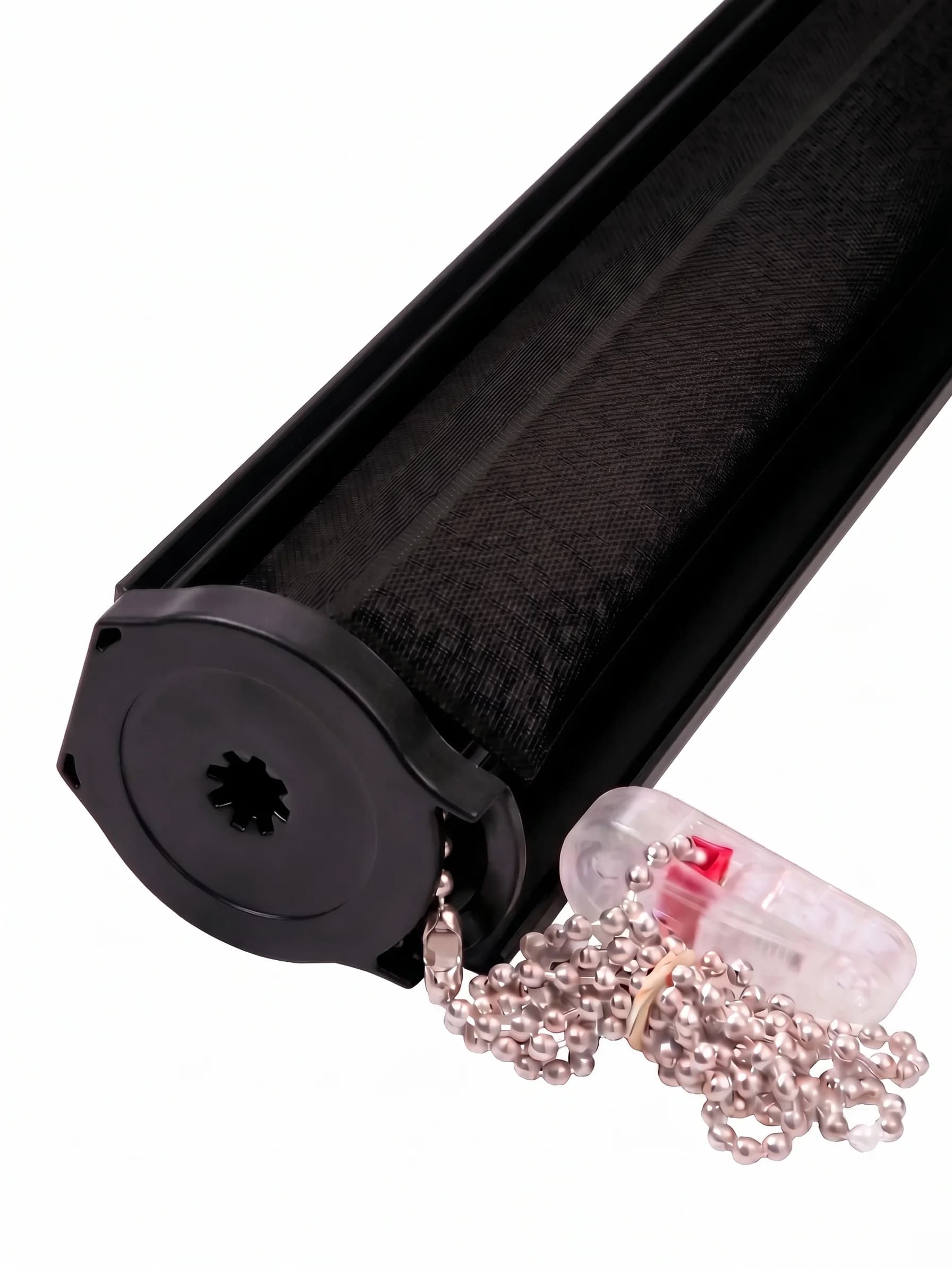
What office solar shades are (and are not)
Solar shades are light-filtering mesh rollers with a stated openness factor. They reduce glare and UV while preserving an outdoor view. They are not blackout, not window film, and not a substitute for motorized building automation on WELL-commissioned towers.
Home Builder Blinds maps the commercial “solar screen” category to Green 2000 and Green 3000 light-filtering fabrics in black and other colors, at 1% and 3% openness, with optional or included aluminum fascia.
Openness factor: 1% vs 3%
Openness factor (OF) is the approximate open area of the weave. Lower OF = stronger glare control and more daytime privacy; higher OF = more view and brightness.
| Openness | Best for | Tradeoff |
|---|---|---|
| 1% | West/south desks, screen-critical private offices, harsh sun | Dimmer feel; less view sparkle |
| 3% | General open offices, east exposures, balanced floors | Still strong glare control with better view |
SKU note
Our light-filtering checkout options are 1% and 3%. Industry guides often mention 5% for soft north light — for that exposure we publish 3% as our soft-exposure SKU, or keep shades raised more often when maximum daylight is the priority.
Color physics: why black solar wins for offices
At the same openness, dark fabrics usually deliver clearer outward view and better monitor comfort because the shade does not become a bright glowing surface. Light fabrics reflect more solar energy (better for interior heat rejection) but can haze the view and increase perceived glare on screens.
That is why we lead workplace copy with black solar shades — charcoal/black Green fabric — for desk-heavy environments. Choose lighter colors when cooling load dominates and screens are secondary, or when design intent demands a bright lobby.
- Do claim: dark fabric helps glare control and view-through vs light at the same OF
- Do claim: light fabric favors solar reflectance / heat rejection
- Do not claim: black interior shades “keep rooms cooler” (often false for interior installs)
- Do not claim: light fabric is “better for office glare” — that confuses heat with visual comfort
Orientation matrix (apply on top of room defaults)
| Façade | Suggested OF | Color note |
|---|---|---|
| West | Prefer 1% | Black for afternoon glare |
| South | 1–3% | Black at workstations |
| East | 3% (1% if monitors face glass) | Morning hit is shorter |
| North | 3% (our soft-exposure SKU) | Light color OK if heat/aesthetic leads |
Day vs night privacy
Solar mesh gives useful daytime privacy when the outside is brighter than the room. At night with interior lights on, the effect reverses — people outside can see in more easily. Solar alone is not night privacy. Pair a blackout roller for conference rooms, street-facing private offices, and after-hours confidentiality.
Optical vocabulary (without inventing your numbers)
Architects may ask for Tv / VLT, Ts / Rs / As, or SHGC. Openness factor is not identical to visible transmittance — color changes how much diffuse light the fabric passes. We publish openness and use-case guidance here; exact optical tables belong on mill fenestration sheets for the selected colorway. Ask when a modeling package is required.
Fascia and wide glass
Finish commercial headers with color-matched aluminum fascia cassette (3" or 4"). Wide curtainwall and ribbon windows often need wide-width rollers — we fabricate up to 144" on a reinforced tube.
DFW solar defaults by submarket
Use the openness ladder below as a starting point for Dallas–Fort Worth glass, then sample black 1% vs 3% in the actual west room when the floor sets a standard.
| DFW area | Start with | Why |
|---|---|---|
| Uptown / downtown Dallas towers | Black 1% on W/SW desk banks | Afternoon washout on monitors |
| Legacy West / Frisco Class AA | Black 1–3% + fascia | Views are the amenity — keep them crisp |
| Las Colinas / Irving campuses | Black 3% open; 1% S/W | Mixed campus + high-rise exposures |
| Fort Worth CBD / West 7th | Black 1–3% by façade | Same Texas west load, different skyline |
| Richardson / Plano tech corridors | Black 3% default | Open workstations + perimeter glass |
Shop & next steps
- Shop roller shades
Green 2000 / 3000 light-filtering and blackout — cut to size.
- Wide-width rollers
Commercial glass up to 144" on a single tube.
- Schedule a DFW measure
On-site measure and install for occupied suites.
- Commercial quote
Multi-window RFQs, TI packages, and nationwide ship.
- Request samples
Compare black 1% vs 3% openness in your light.
Frequently asked questions
What are the best solar shades for offices?
Black or charcoal solar mesh at 1% or 3% openness is the practical default for computer workspaces. It balances glare control with outward view. Confirm orientation — west glass in Uptown and Legacy West often wants 1%.
Are black solar shades the same as blackout?
No. Black solar means dark mesh color. Blackout is a separate opaque fabric. You can run black solar for daytime work and add blackout for presentations.
3% or 5% for open offices?
Many commercial guides cite 3–5% as a sweet spot. Our Green light-filtering line is offered at 1% and 3%; we treat 3% as the balanced open-office default and 1% for harsh exposures.
Do solar shades block UV?
Solar screen fabrics substantially reduce UV exposure compared with untreated glass; blockage roughly tracks how closed the weave is. Ask for fabric documentation if you need a stated UV percentage for a submittal.
Can I get samples before a multi-window order?
Yes. Request samples and compare black 1% vs 3% in the actual room — especially on west glass — before locking a floor standard.
Related guides
- Blinds for offices hub
Zone matrix, product paths, and DFW commercial guidance.
- Office glare control
Monitor glare, west glass, and openness picks.
- Conference room shades
Work mode solar + presentation blackout.
- Metal fascia for rollers
3" / 4" aluminum cassette that conceals the tube.
- Blinds for home offices
Residential desk / WFH window treatments.
Ready to outfit the glass?
Configure black solar and blackout rollers online, request samples for openness compare, or get a commercial quote for multi-window floors. DFW teams measure and hang from our Irving shop — including occupied suites after hours.