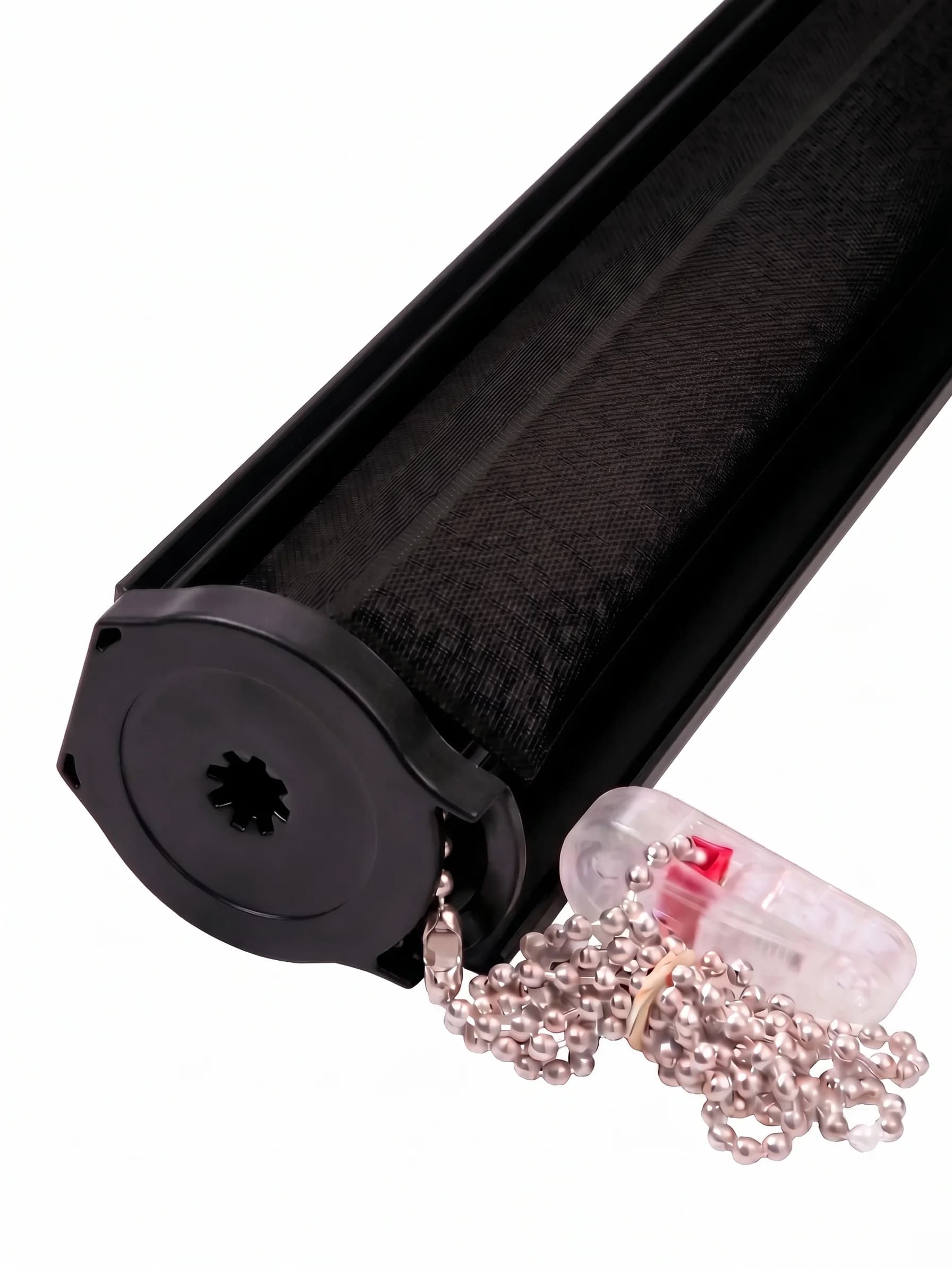
Why traditional “office blinds” fail on modern glass
Open-plan and Class A suites put monitors in front of floor-to-ceiling glass. Horizontal minis and closed vinyl leave stripes of glare, collect dust, and look residential from the street. Commercial solar roller shades keep the view, calm screen washout, and read as one clean fabric band across a façade.
In Dallas–Fort Worth and other Sunbelt markets, west- and south-facing glass also drive HVAC complaints. Shades will not replace high-performance glazing or film, but they are the adjustable layer facility managers reach for when perimeter desks overheat and tickets pile up.
Zone matrix: what to specify by space type
Do not put one fabric on every opening. Start with how the room is used, then adjust openness for façade orientation.
| Space | Default fabric | Openness / color | Notes |
|---|---|---|---|
| Open office / workstations | Solar (light-filtering) | Black 3% (1% on harsh W/S) | Prioritize monitor comfort + view |
| Private / executive office | Solar | Black 1–3% | Optional blackout if night privacy matters |
| Conference / boardroom | Solar + blackout | Black solar 1–3% + blackout | Work mode vs presentation mode |
| Reception / lobby | Solar | Black 3% or lighter if “bright lobby” | Fascia for a finished public header |
| Medical / dental / law | Solar (+ blackout where private) | Dark 1–3% | Daytime privacy; blackout for exams / consults |
| Schools / admin | Solar (+ dual for AV) | Black 3% classroom default | Fascia/cassette; cordless preferred where rules apply |
Open offices and perimeter desks
Open workstations are primarily a glare-management problem. Occupants face screens for hours; reflected west and south sun washes monitors and drives facility tickets. Default to black Green-series solar at 3% openness, dropping to 1% on west/south banks where desks face the glass.
- Keep fabric language consistent across a floor for a Class A exterior look
- Group openings by façade when quoting — elevation matters more than floor number
- Link wide curtainwall runs to wide-width rollers (up to 144")
Conference rooms and glass boardrooms
One fabric cannot do daylight meetings and AV presentations well. Spec a black solar roller for Work Mode and a separate blackout roller for Presentation Mode. Order two shades per opening; each can take a matching aluminum fascia cassette.
Deep dive
See Conference room shades for the Work vs Presentation framework, night “fishbowl” honesty, and how to order the pair without claiming dual-cassette motorized systems.
Conference room shades →Product stack for workplace glass
- Solar shades for offices — openness, black fabric science, orientation matrix
- Office glare control — monitor-focused guidance for east/west exposures
- Metal fascia — 3" / 4" aluminum cassette that conceals the roller
- Conference room shades — solar + blackout pairing
- Shop /roller-shades and /roller-shades/wide-width for cut-to-size commercial glass
DFW submarkets: Texas sun on Class A glass
North Texas offices deal with intense afternoon west load, 100°F summers, and floor-to-ceiling glass. Spec by elevation and submarket — not one SKU for the whole floor. Local winners talk openness by façade and after-hours install, not “elegant light filtering.”
Texas institutional practice often points toward lower openness on south/west glass and medium-to-dark fabrics for screen work. We publish that as guidance and map it to Green 2000/3000 at 1% and 3% (our light-filtering openness options).
- West / south desks → black 1% when monitors face glass
- East / softer exposures → black 3% balance of view and glare
- Occupied suites → schedule measure and phased / after-hours install in DFW
- Multi-site or out-of-market → cut-to-size ship nationwide
DFW office submarkets we commonly measure and quote
| Submarket | Glass / sun pattern | Starting shade note |
|---|---|---|
| Uptown / McKinney Ave | Tower curtainwall; hard west/southwest afternoons | Black 1% on west desks; fascia for street-facing bands |
| Legacy West / Frisco / Plano | Class AA F2C glass, skyline views as amenity | Keep view; dark 1–3%; wide rollers on ribbon glass |
| Las Colinas / Irving | Campus + high-rise mix; west heat + parking-lot glare | Zone by elevation; after-hours TI installs common |
| Design District / Stemmons | Creative offices, mixed depth, retrofit frames | Confirm mount depth; cordless + fascia for clean headers |
| Preston Center / Park Cities edge | Mid-rise professional suites, client-facing lobbies | Black 3% default; blackout for conference rooms |
| Fort Worth CBD / West 7th | West sun on downtown and mixed-use glass | Same openness ladder; DFW measure / phased hang |
| Richardson / Telecom Corridor | Campus glass + open workstations | Black 3% open office; 1% on S/W monitor banks |
| Arlington / Grand Prairie light industrial offices | Shallower frames, practical TI budgets | Manual solar + fascia; quote by opening schedule |
Local cut + install moat
National brand pipelines often quote multi-week lead times. For DFW TI and make-ready, we cut to measured openings, remake punch-list sizes without coast-to-coast freight drama, and hang around live floors when you need evenings or weekends.
DFW office installation from Irving
Professional office-blind installation is Dallas–Fort Worth only. We measure, cut, and hang from our Irving shop — not a national franchise dispatching a contractor you have never met.
Home Builder Blinds L.L.C. is based at 7301 N State Highway 161, Suite 148, Irving, TX 75039. Call (682) 204-1076 to scope a suite. Occupied offices get a daytime measure, then a phased hang — evenings or weekends when the floor is live — so desks stay working.
Install is a local crew job: confirm mount depth on curtainwall, match fascia color across a façade, and remake punch-list sizes in Irving instead of waiting on a coast-to-coast remake. Outside the metroplex we cut to size and ship; your crew or a local installer hangs.
- Measure on-site in DFW occupied suites, TI buildouts, and make-ready floors
- After-hours and weekend hangs when the office cannot shut down
- Cut and remake from Irving — punch-list sizes without freight delay
- Nationwide ship for offices outside Dallas–Fort Worth
How a DFW office install actually runs
1) Quote from an opening schedule or walk the floor. 2) Measure with access coordinated through your property or GC. 3) Cut solar and blackout rollers in Irving. 4) Hang in one or more visits — after-hours if the suite is occupied. 5) Punch-list remakes stay local.
Irving shop · DFW install
Home Builder Blinds L.L.C.
Office install cities we serve
Manual cordless / chain vs motorization
Tall banks and hard-to-reach curtainwall often justify motorization and building automation on Class A projects. Home Builder Blinds fabricates cordless and continuous cord loop (chain) rollers for TI and facility projects — we do not sell a motorized WELL L05 / BMS package.
Honest scope
If your project requires automated glare control, solar tracking, or Lutron/Mecho-class integration, engage an automation partner. We still supply commercial-ready solar and blackout fabrics with aluminum fascia for many TI and retrofit scopes.
Commercial documentation
Lead with performance: glare, UV filtering, heat-gain management, daytime view, and finished aluminum fascia. Fire (NFPA 701), GREENGUARD, and similar labels are fabric- and SKU-specific — ask for documentation when a GC or facility checklist requires submittals. We do not claim sitewide LEED or WELL product certification.
Workplace offices vs home offices
Looking for a residential desk or WFH setup? Use our home office blinds guide. This cluster is for commercial suites, TI buildouts, schools/admin, and medical/professional workplaces.
Shop & next steps
- Shop roller shades
Green 2000 / 3000 light-filtering and blackout — cut to size.
- Wide-width rollers
Commercial glass up to 144" on a single tube.
- Schedule a DFW measure
On-site measure and install for occupied suites.
- Commercial quote
Multi-window RFQs, TI packages, and nationwide ship.
- Request samples
Compare black 1% vs 3% openness in your light.
- DFW commercial installation
Occupied-suite and TI hang from our Irving shop.
Frequently asked questions
What are office blinds?
Office blinds are commercial window treatments for workplace glass — typically black solar roller shades (office shades) at 1% or 3% openness, not residential mini blinds or home-office décor. They cut monitor glare, keep the view, and finish with aluminum fascia so the header looks like part of the building.
What office shades work best for desks and open offices?
Black solar office shades at 3% openness are the default for open offices; use 1% on west or south glass when monitors face the window. Conference rooms usually add a separate blackout roller. This page is for commercial suites — home offices use a different stack.
What window treatments work best for commercial offices?
Black solar roller shades at 1% or 3% openness are the workplace default for desks and open offices — they cut monitor glare while keeping the view. Conference rooms usually need a second blackout roller for presentations. Finish headers with aluminum fascia so hardware stays hidden.
Are solar shades the same as blackout?
No. Solar (light-filtering mesh) softens daylight and glare but is not opaque. Blackout fabric is a separate line for projection, privacy after dark, and true room darkening. Many conference rooms need both.
What openness factor should we use?
Start with black 3% for general open offices. Use 1% on west/south glass or when monitors face the window. We sell Green 2000 and Green 3000 light-filtering at 1% and 3% openness — compare samples in the actual room light when you can.
Do you install office blinds in Dallas–Fort Worth?
Yes. Professional install is DFW-only, run from our Irving shop at 7301 N State Highway 161, Suite 148. We measure occupied suites, cut solar and blackout rollers locally, and hang during the day or after hours so the floor stays open. Call (682) 204-1076 or schedule a measure. Offices outside the metroplex get cut-to-size ship.
Can you install in an occupied office after hours?
Yes for DFW jobs. Typical flow is a daytime measure with building access, then an evening or weekend hang so desks are not disrupted. Multi-floor TI can be phased by elevation or suite. Confirm freight elevator and after-hours rules with your property team when you book.
What office shades work best in Uptown Dallas or Legacy West?
Floor-to-ceiling Class A glass usually wants black solar at 1% on west/southwest desk banks and 3% where exposures are softer, plus aluminum fascia so the header reads finished from the street. Conference rooms should add a separate blackout roller for presentations.
Do you cover Las Colinas, Frisco, and Fort Worth offices?
Yes. Those submarkets share the same Texas west-glass problem with different building stock. We quote by opening schedule and elevation, then measure and install from Irving across Las Colinas, Frisco, Fort Worth, Plano, Dallas, and the rest of DFW — or ship cut-to-size for your crew outside the metroplex.
What is metal fascia on a roller shade?
An extruded aluminum cassette (3" or 4") that conceals the roller tube and operating hardware when the shade is raised. Cordless builds include a color-matched fascia; continuous cord loop can add it optionally.
Can shades help with Texas cooling costs?
Solar shades help manage solar heat gain and comfort on large glass, especially west exposures in Uptown and similar towers. Exact energy savings depend on glass, orientation, and building systems — we describe directional comfort benefits rather than guaranteed kWh reductions. Some property managers also evaluate film as a complementary layer.
Do you meet NFPA 701 or GREENGUARD?
Those claims are fabric-specific and require current test reports or certificates for the selected SKU. Ask us for documentation on your project checklist rather than assuming a sitewide badge.
How is this different from blinds for home offices?
Home office pages target residential desks, video calls, and builder bedroom-module sizes. This workplace cluster targets commercial glass, facility managers, TI, and conference AV needs with solar + fascia as the authority story.
Related guides
- Solar shades for offices
Openness, black fabric, and orientation defaults.
- Conference room shades
Work mode solar + presentation blackout.
- Metal fascia for rollers
3" / 4" aluminum cassette that conceals the tube.
- Office glare control
Monitor glare, west glass, and openness picks.
- Blinds for home offices
Residential desk / WFH window treatments.
- Commercial accounts
Property managers, multifamily, and volume programs.
- DFW commercial installation
Occupied-suite and TI hang from our Irving shop.
Ready to outfit the glass?
Configure black solar and blackout rollers online, request samples for openness compare, or get a commercial quote for multi-window floors. DFW teams measure and hang from our Irving shop — including occupied suites after hours.